


Anti-Drone Technology Market: Strategic Insights and Market Dynamics
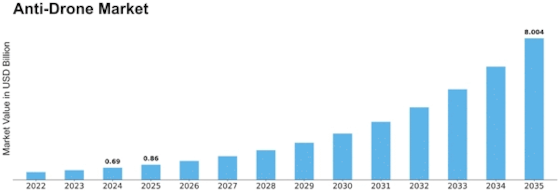
The Anti-Drone Market was valued at approximately USD 0.55 billion in 2023 and is forecast to reach about USD 2.62 billion by 2032, with a CAGR near 25 % from 2024 through 2032.This strong growth trajectory reflects the urgent need to manage drone risks across defence and civilian domains alike.
Industry Overview
Drones have surged in popularity for both commercial innovation and tactical operations—but their misuse is equally widespread. From illicit smuggling over borders to unauthorized flights near airports and large events, the risk scenarios are real and varied. The anti-drone industry answers this challenge with systems capable of detection (sensing, tracking, identification) and neutralisation (jamming, lasers, other counter-measures). As governments and enterprises place higher value on airspace control, the industry’s relevance continues to intensify.
Key Players Role
Market incumbents play a significant role in shaping innovation and deployment. For example, DroneShield has developed solutions suited to urban event security, while Dedrone specialises in sensor and software-centric detection platforms. On the defence side, large players such as Lockheed Martin and Raytheon Technologies embed anti-drone capabilities into broader air defence systems. These companies drive economies of scale, certification maturity and accelerated adoption of counter-drone technologies.
Segmentation Growth
Segment-wise trends to note:
- Detection (Application): Radar continues to dominate detection usage due to its broad coverage capability. However, EO/IR and acoustic technologies are increasingly used as complementary sensors in layered architectures.
- Interdiction (Neutralisation): The jammer segment leads in neutralisation technology, owing to its established use. Emerging methods like lasers and other directed-energy systems are gaining ground in high-end applications.
- Platform: Ground-based systems are the largest, but handheld and UAV-based counter-drone platforms are rising in importance, especially for mobile and tactical deployments.
- End-User: Defence constitutes the main consuming segment today. Nevertheless, commercial domains—aviation hubs, large public events, critical infrastructure—are becoming meaningful growth markets as drone use expands and regulation tightens
Conclusion
The anti-drone market is accelerating in response to an evolving drone threat landscape and strong demand for airspace security. Vendors and system integrators that focus on multi-sensor detection, modular neutralisation systems and adaptability for commercial deployment will be best positioned. Meanwhile, organisations seeking to protect their airspace would do well to evaluate counter-drone options proactively and incorporate them into broader security strategies.
Related Report:

 English
 Arabic
 French
 Spanish
 Portuguese
 Deutsch
 Turkish
 Dutch
Dutch
 Italiano
 Russian
 Romaian
 Greek
Greek